
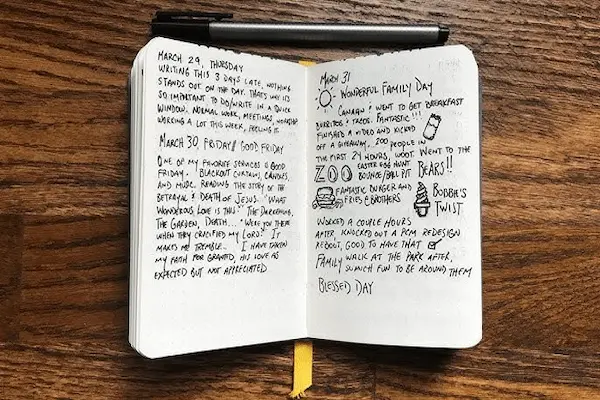
Instead of treating journaling as a huge self improvement task that needs a special desk, complex prompts and unlimited time, you can approach it as a five minute mental reset that helps you sort thoughts, park worries and see your next step a little more clearly.
Overthinkers often have plenty of ideas and reflections already, yet they lack structure and a routine that feels small enough to use on busy days, which means a calm, option rich journaling system can make a bigger difference than a dramatic one time writing session.
This guide is designed to show you how to journal for clarity using very simple tools, seven practical journaling prompts, a repeatable five minute format and a printable style template layout you could easily turn into a PDF if you want a physical page to work from.
Throughout the article, the focus stays on mental clarity and gentle reflection rather than on deep trauma processing, therapy level work or any promise of dramatic overnight change, because those areas belong with trained professionals and longer term support.
By the time you reach the end, you will have a menu of journaling routines you can plug into mornings, lunch breaks or evenings, plus an honest sense of what this practice can realistically do for you and where its limits sit.
Scope and expectations: what clarity journaling can and cannot do
Being transparent about scope is part of journaling responsibly, because writing can be powerful for mental clarity, yet it is not a magic button for every kind of distress or life problem.
Short, structured writing sessions tend to help with everyday mental clutter, swirling to do lists, overanalyzing small situations and mild to moderate stress, especially when they are used consistently for several days or weeks.
Simple journaling methods like the ones in this guide are not designed to treat severe depression, complex trauma, active crisis situations or conditions that make it hard to function in daily life, and taking those issues to a qualified professional is always the safer and more respectful choice.
Thinking of journaling as one tool in a wider routine works best, so this practice can sit alongside things like sleep care, movement, social connection, therapy, medication or coaching rather than trying to replace any of them.
It is also worth remembering that not everyone likes to write for long, which is why the focus here is on brief reflection and clear templates, so you can experiment without feeling trapped in long, emotional sessions if that is not what you need right now.
What “journaling for clarity” actually means in everyday language
Clarity journaling is less about documenting everything that happened and more about taking a small slice of your inner world, placing it on the page and examining it long enough to see patterns, priorities and options that were blurred in your mind.
Rather than writing long stories about your day, you capture key thoughts, feelings, questions and worries, then reorganize them in a way that helps your brain stop replaying the same scenes and instead move toward decisions or gentle acceptance.
In practical terms, journaling for clarity usually includes three moves that repeat again and again, regardless of which prompt you choose or how much time you have that day.
First comes capture, where you get the raw material out of your head and onto the page in a messy, honest way, without worrying about spelling, style or depth.
Next comes organize, where you group, sort and label what you wrote, turning an overwhelming cloud of thoughts into a smaller number of categories, lists or insights that you can actually hold in your attention.
Finally comes choice, where you decide one small action, attitude or focus you want to carry into the rest of your day, so the page becomes a launchpad rather than just a storage space for complaints.
Once you start seeing those three moves, it becomes much easier to adapt journaling prompts to your own style, because you will know exactly what each step is supposed to do for your mental clarity.
Five minute clarity format: a routine you can actually keep
Busy and overthinking minds rarely need an open ended blank page as their default, they need a five minute container that feels manageable, repeatable and structured enough to hold wandering thoughts without letting them spill everywhere.
The short routine below is built specifically for mental clarity rather than deep life history work, and you can use it with almost any of the seven journaling prompts that appear later in this guide.
Five minute clarity session in four phases
- Phase 1 – One minute check in where you name the time, place and rough emotional weather inside your head.
- Phase 2 – Two minute brain dump where you write quickly and unfiltered about what is crowding your attention right now.
- Phase 3 – One minute organize and highlight where you circle themes, draw arrows or underline the phrases that clearly matter most.
- Phase 4 – One minute decision where you choose one focus, next step or gentle intention to carry into the rest of your day.
How each phase looks on the page
- In Phase 1, you might simply write “Tuesday, lunch break, feeling scattered and a bit tense,” which anchors you in the present moment without needing a long intro.
- During Phase 2, you fill lines as quickly as you comfortably can, letting worries, reminders, snippets of conversation and to do items appear in any order, since neatness is not yet the goal.
- Phase 3 gives you permission to pause, glance back over the mess and mark repeated ideas, urgent tasks, recurring feelings or questions that sound loudest when you read them back.
- By Phase 4, you want a single sentence that finishes a starter like “For the next few hours, I will focus on…” or “Today, the only piece of this I will act on is…”, because one clear focus is far easier to remember than six competing priorities.
Running through this format once can feel helpful, yet the real strength of this routine appears when you use it several times over a week, since your brain begins to associate the journal with a predictable clarity process rather than with open ended rumination.
Seven journaling prompts for mental clarity and brief reflection
Prompts act like doors into the same house, so each one here leads you back to the three core moves of capture, organize and choice, while using slightly different angles that keep journaling from feeling repetitive or stale.
All prompts in this balcony of options are designed for short sessions and can be combined with the five minute routine you just saw, which means you are never stuck wondering where to begin on a busy day.
Prompt 1 – “Right now my mind is full of…”
This simple sentence starter gives your thoughts immediate permission to step forward, which can be enough to stop them queueing impatiently in the back of your mind.
- Set a timer for two minutes and repeatedly begin lines with “Right now my mind is full of…”, finishing the sentence each time with whatever pops up, no matter how small or odd it seems.
- After the timer ends, scan what you wrote and circle any words or phrases that appear more than once, since repetition is often a sign of an issue that needs attention or a feeling that has not been acknowledged properly.
- Use the last minute of your session to choose one circled item and write, “Today, I will make this one notch smaller by…” and fill in one realistic step that would lower its intensity a tiny bit.
Prompt 2 – “Three things I can park for later”
Mental clarity does not come only from solving problems, it also comes from explicitly deciding which problems do not deserve immediate attention today, so your brain can stop trying to juggle every single one at once.
- Draw three short columns and label them “Not today”, “Next week” and “When I have more energy”, giving yourself permission to use all three.
- List one thought or task in each column that you are choosing to postpone on purpose, explaining in a short phrase why you are deferring it and how you will know when it is time to revisit it.
- During the final minute, write one sentence starting with “By parking these three things, I create room for…” and name the one priority that truly needs attention today.
Prompt 3 – “If my thoughts were browser tabs…”
Many overthinkers describe their mind as a browser with dozens of tabs open, so turning that metaphor into a written list can suddenly make the chaos feel more manageable and even a little humorous.
- Imagine your current worries and tasks as open browser tabs and list them down the page using short phrases like “budget spreadsheet,” “text from friend,” or “worry about performance review.”
- Next to each line, draw a small symbol such as a star for “keep open today,” a pause sign for “can be background,” and an X for “can be closed for now,” basing your decisions on real constraints, not perfect conditions.
- Choose one starred tab and write two sentences about what a good enough outcome for that topic looks like today, then close the journal by physically crossing out at least one X tab, saying to yourself that it is closed for now.
Prompt 4 – “Questions I do not have to answer right now”
Clarity often improves when you stop forcing yourself to answer huge life questions on a random Tuesday evening, and instead give yourself written permission to let some of them remain open for a while.
- Write down up to five big questions that keep returning in your thoughts, such as “Am I in the right job” or “Where should I live next year,” leaving space below each line.
- Under each question, jot a brief note explaining why deciding this today is neither required nor realistic, which gently loosens the pressure to resolve it immediately.
- Pick one question and finish the session by writing, “For now, the smallest sensible step on this question is…” and give yourself one concrete, low effort action like talking to a specific person or reading one article.
Prompt 5 – “Three things that are actually okay today”
Clarity sometimes gets drowned out by a bias toward problems, therefore naming what is steady or quietly working in your life helps you see reality with more balance and less catastrophe.
- Write a heading that says “Three things that are actually okay today” and list three specific examples, such as “my body feels generally fine” or “my rent is paid this month.”
- Under each item, add a short line about why that piece of okayness matters, which reminds your nervous system that the world is not entirely on fire.
- Conclude by writing a sentence that starts with “Remember, not everything is broken because…” and let your own words fill in the rest, using concrete details where possible.
Prompt 6 – “If I only cared about the next hour…”
Overthinking often zooms too far into the future, so deliberately shrinking your time horizon down to one hour can clear mental clutter by temporarily removing everything that does not belong in that small window.
- At the top of a page, write “If I only cared about the next hour, I would…” and then list three tiny actions or mindsets that would genuinely help, such as “drink some water,” “reply to one email,” or “take a ten minute walk.”
- Circle the one option that is both helpful and realistically achievable with your current energy, making sure it does not depend on other people changing first.
- Use the last minute to write a brief contract to yourself, for instance “For the next hour, I agree to focus only on this one action and let everything else wait until later.”
Prompt 7 – “Future me will be grateful that I…”
Thinking in terms of your future self can align daily actions with deeper values, which often brings a sense of calm and direction when you feel scattered by many small demands.
- Finish the sentence “Tonight, future me will be grateful that I…” three times, letting each ending point to a different area such as health, relationships or practical matters.
- For each line, add one starter step that would move you toward that outcome, keeping it tiny enough that you could complete it in ten minutes or less if needed.
- Choose one line to act on today and write it again in bolder, slightly larger letters, which signals to your brain that this is the focus you are choosing to hold after closing the notebook.
Template layout: turning how to journal for clarity into a printable page
Having a fixed page layout often removes friction, because you do not have to decide where to write what each time you sit down, and that alone can make a clarity routine easier to maintain.
Although this article cannot provide an actual PDF file, it can describe a layout that you or an editor could quickly turn into a printable template with a few simple boxes and headings.
Daily clarity template structure
- Top band – Date and quick weather report, giving space to write the date, time of day and a one word mental weather label like “foggy,” “rushed” or “steady.”
- Section A – Two minute brain dump box covering about one third of the page, with a light title such as “What’s on my mind right now.”
- Section B – Themes and highlights strip placed underneath, divided into three short lines labeled “Most repeated thought,” “Biggest current worry,” and “Nice surprise or win.”
- Section C – Today’s prompt area occupying the next third of the page, with a blank line to write one of the seven prompts and space beneath for a few sentences or bullet points in response.
- Section D – One focus line at the bottom, starting with “The one thing I choose to carry from this page into the rest of today is…” followed by a long blank line for a single clear sentence.
Weekly review template structure
- A short grid with seven boxes labeled Monday through Sunday, where you can jot a three word summary of each day’s main mental theme.
- Another row with three larger boxes titled “Things that kept coming up,” “Things that actually helped,” and “One experiment for next week.”
- A final strip for a gentle self note, beginning with “Overall, I am learning that my mind…” and leaving plenty of room for reflection without pressure to write perfectly.
Building a calm journaling routine around your day
Knowing how to journal for clarity is one part of the puzzle, while finding a sustainable routine that fits your real life is the part that quietly decides whether this practice sticks or fades after a handful of entries.
Because schedules, energy levels and responsibilities differ, it can be helpful to think in terms of routine options rather than one official ideal pattern that you might struggle to maintain.
Morning clarity routine option
- Use the five minute format soon after waking or while drinking your first coffee or tea, treating it as a way to shift from sleep brain to planning brain more gently.
- Pair the practice with an existing habit such as brushing teeth, feeding pets or checking your calendar, so you do not have to rely solely on motivation to remember it.
- Keep expectations low, allowing sleepy or scattered pages, and simply ask whether you feel one notch more organized afterward, rather than whether the writing looked impressive.
Midday reset routine option
- Take five to ten minutes at lunch or in a mid afternoon lull, particularly on days when you can feel your focus slipping or stress rising, and use a prompt like the browser tabs or one hour exercise.
- Set a timer to protect your break so the session does not expand until you feel rushed, which would undermine the whole purpose of calming your mind.
- After closing the notebook, do one micro action from your clarity sentence straight away, even if it is as small as sending a two line email you had been avoiding.
Evening wind down routine option
- Reserve a five minute slot close to bedtime, perhaps after brushing teeth or stretching lightly, and use prompts that park questions, highlight okay things or thank future you.
- Avoid expanding into a long post mortem of the entire day unless you genuinely want that, since the aim here is to clear clutter, not to overactivate your mind before sleep.
- Notice whether sleep feels a bit easier on evenings when you offload worries onto paper, and let that evidence inform whether an evening routine is a good fit for you.
Common blocks and gentle ways around them
No matter how elegant a routine looks on paper, real people run into resistance, and naming those blocks ahead of time can make it easier to respond with kindness and practical tweaks rather than self criticism.
Block – “I do not know what to write”
- Use the exact wording of a prompt as your first line and treat it as a call and response, answering it with any fragment that comes, even if it feels clumsy.
- Set a tiny minimum, such as “one sentence counts as journaling,” and allow yourself to stop after that on very tired days, which often removes pressure and paradoxically makes it easier to continue.
- Keep a mini list of favorite prompts on the inside cover of your notebook, so you are never waiting for inspiration before you can start.
Block – “I am afraid journaling will make me feel worse”
- Stay close to lighter prompts that focus on parking thoughts, narrowing time horizons or naming okay things, especially at the beginning of your practice.
- Set a firm time limit for sessions and include a small grounding action afterward, such as stretching, drinking water or looking around the room and naming five things you can see.
- If writing regularly leaves you more distressed or starts pulling you into heavy material you do not feel equipped to handle, see that as information that professional support might be more helpful than self guided journaling alone right now.
Block – “I start strong and then forget for weeks”
- Think of your journaling routine like a flexible relationship rather than a rigid streak, which means you can always restart without penalty after time away.
- Put visual reminders in places you regularly look, such as a small sticky note on your laptop or nightstand that simply says “five minute clarity.”
- Link journaling to a regular weekly event, for example using the weekly review template every Sunday evening or Monday morning, even if you did not write daily entries that week.
How this guide was built and how to adapt it for yourself
Methods in this guide reflect patterns that editors and writers have tested in real notebooks and digital apps, with attention to what actually feels doable when brains are tired and days are busy, not only what looks tidy in a theoretical journaling system.
Techniques also draw heavily on common sense principles from cognitive and behavioral approaches, such as narrowing focus, separating thoughts from facts, shrinking time frames and making one small decision at a time, though this text does not attempt to act as formal therapy or coaching.
Adapting the ideas to your own context is not only allowed, it is encouraged, because the most effective journaling routine is the one you are willing to actually use, even if it ends up looking simpler than the full set of options described here.
Some people will prefer freehand paragraphs with minimal structure, others will lean on templates and bullet points, and both groups can still follow the capture, organize and choice arc that lies at the heart of clarity focused journaling.
Bringing it all together: your personal how to journal for clarity plan
Learning how to journal for clarity is ultimately about building a small, repeatable bridge between the inside of your head and the rest of your life, so that thoughts do not just spin but actually lead to gentler decisions and more grounded action.
Seven prompts give you different angles on the same goal, a five minute routine keeps the practice contained, and a simple template layout makes it easier to show up even when you feel scattered or short on time.
Routine options for morning, midday and evening create flexibility rather than pressure, while the sections on blocks and scope help you stay honest about what journaling can do on its own and when it might be wiser to ask for help beyond the page.
If you treat each short session as an experiment, notice how you feel before and after and adjust the pieces that do not quite fit, you will gradually build a personal system that clears enough mental clutter to matter without demanding more than you can reasonably give.