
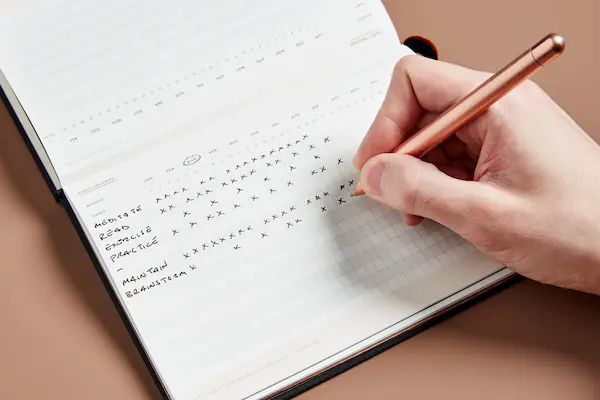
Many people hear the words habit tracking and immediately picture complicated apps, color coded calendars and productivity systems that feel overwhelming when all they really want is a calm way to build two or three small habits at once without turning life into a project.
Instead of acting like a scoreboard that shames you for every blank square, a habit tracker for everyday balance can become a simple, visual reminder that your efforts count, that progress can be tiny and consistent, and that you are allowed to start where you are rather than where some ideal version of you might be.
When you think of a tracker as a friendly tool that highlights patterns rather than as a judgmental report card, you begin to see that it can help you understand when habits feel easy, when they feel difficult and what kind of routine actually works with your real schedule.
Beginners who are building just two or three habits at the same time benefit especially from a clear yet gentle layout, because a visually simple printable sheet or page reduces decision fatigue and makes it obvious what to do today without needing to scroll or tap through screens.
This article will walk you through how to design and use a habit tracker for everyday balance that focuses on sustainable progress, offers a printable template, gives concrete weekly review steps and provides troubleshooting ideas when things do not go as smoothly as you hoped.
What a habit tracker for everyday balance really is and what it is not

At its core, a habit tracker for everyday balance is a visual record of whether you gave attention to certain actions on specific days, and it usually takes the form of a grid, a list with checkboxes or a simple table that you can print and mark with pen or pencil.
The aim is not to create a perfect streak that never breaks, and it is not to monitor every part of your life in microscopic detail, but rather to gently support routines that matter to you, such as drinking water, stretching for a few minutes, reading a page or simply going outside for fresh air.
Habit tracking becomes more balanced when you choose only a small number of habits, keep the actions realistically small and let the tracker show patterns without turning every missed day into a failure story.
When used thoughtfully, the tracker serves as a mirror that reflects your week, helping you notice which days feel heavier, which habits slip when you are stressed and where a tiny adjustment could make things easier.
It is not meant to replace intuition, rest or self compassion, and it is not a moral scale that ranks you as good or bad based on how many boxes are filled, because your worth never depends on how tidy your chart looks.
Key features of a balanced habit tracking approach
- Simple enough to understand at a glance, even when you are tired or distracted at the end of the day.
- Focused on only two or three habits at a time so that your attention is not scattered in dozens of directions.
- Flexible enough to live on paper as a printable, in a notebook or on a wall where you can see it easily.
- Encouraging in tone, with room for notes, gentle reflections and small wins instead of only yes or no marks.
- Designed to help you learn about your rhythms, not to force you into someone else’s ideal routine.
Principles for sustainable habit tracking when you are just starting out
Before you draw any lines on a printable page, it helps to ground your habit tracker for everyday balance in a few principles that keep things realistic, kind and sustainable, especially when you have a beginner’s level of confidence and are juggling more than one habit at the same time.
These principles work like guardrails, silently keeping your expectations within a range that supports long term progress rather than short bursts of effort followed by burnout or guilt.
Five principles that keep habit tracking supportive rather than stressful
- Start small enough that you can win most days, which often means making each habit tiny and specific, such as two minutes of stretching or one glass of water after breakfast.
- Track only a few habits at once, ideally two or three, so that you can give each one attention without feeling overwhelmed whenever you look at your tracker.
- Connect habits to real routines you already have, because consistency grows faster when new actions are attached to existing anchors such as meals, commutes or bedtime rituals.
- Use your tracker as information, not as a verdict, which means noticing patterns and adjusting them instead of criticizing yourself for blank spaces.
- Review the week with curiosity, asking what helped and what got in the way, instead of only focusing on how many boxes you filled.
Holding these ideas in mind creates a foundation where your habit tracker becomes a quiet ally in everyday balance instead of an extra source of pressure.
Step by step, how to set up your first habit tracker for everyday balance
Creating a habit tracker can feel complicated when you see elaborate designs online, yet the basic setup can be surprisingly straightforward when you follow a clear series of steps that focus on decisions in a logical order.
The sequence below guides you from choosing habits to printing the template and placing it where it can gently remind you to use it.
Step 1, choose two or three habits that support everyday balance
Balanced habit tracking works best when you start with a very small cluster of actions that touch different parts of your life without demanding too much energy from you at once.
- Pick one habit that supports your body, such as light stretching, short walks or drinking water regularly.
- Pick one habit that supports your mind or emotions, such as journaling a few lines, reading for five minutes or practicing a brief breathing exercise.
- Pick one habit that supports your environment or organization, such as tidying a tiny area, preparing clothes for tomorrow or reviewing the next day’s schedule.
Once you have two or three candidates, rewrite each one so that it is clear and small, for example “two minutes of shoulder stretches,” “read one page” or “clear one small surface on my desk.”
Step 2, decide how many days per week you want to track each habit
Everyday balance does not always mean doing the same thing every single day, and for beginners it is often more helpful to aim for a realistic number of days rather than an ideal seven day streak.
- For each habit, ask yourself how many days you would truly like to do it in a typical week, given your current workload and responsibilities.
- Choose a minimum target that feels achievable, such as three or four days per week for a new habit instead of all seven.
- Note that you can always do the habit more often than your target, and any extra days are a bonus rather than a new requirement.
- Write these target numbers at the top of your tracker so that expectations remain visible and kind.
Step 3, pick a format, printable first and other versions later
Because you are focusing on simplicity and clarity, starting with a printable habit tracker for everyday balance can be extremely helpful, since a sheet of paper on your desk, wall or fridge is easy to see at a glance.
- Choose a weekly tracker if you like to evaluate progress every seven days and reset regularly.
- Choose a two week or monthly tracker if you prefer seeing longer trends and do not mind a bigger sheet.
- Keep the design minimal with clear boxes, short labels and room for a few notes instead of complex graphics.
- Plan to print one new sheet each week or each month, or print several at once and keep them in a folder.
Once the printable structure works well, you can always experiment with notebooks or digital tools, but starting on paper often keeps things tangible and easier to remember.
Step 4, decide when and how you will mark your tracker
Knowing exactly when you are going to interact with your habit tracker for everyday balance can make the difference between a sheet that quietly gathers dust and one that genuinely helps you remember your new routines.
- Choose one moment in the day to mark completed habits, such as right after dinner, before brushing your teeth at night or just before you turn off your work computer.
- Decide what symbol you will use, whether a check mark, a colored dot, a small letter or a simple X in the square.
- Place a pen or pencil next to the tracker so that marking it takes seconds and does not require searching for tools.
- Consider writing a very short note in a dedicated column when something interesting happens, such as doing extra time or skipping for a specific reason.
By defining these details up front, you reduce friction and make it more likely that habit tracking becomes part of your routine instead of an optional afterthought.
Designing a printable habit tracker layout you will actually use
Visual clarity matters a great deal when you are building new habits, because your brain is already doing extra work learning new patterns and does not need to fight with a cluttered page every evening.
A simple table layout usually works well, because it mirrors a calendar in a simplified way and allows you to see both days and habits in a single view.
Basic structure of a weekly printable habit tracker for everyday balance
- Top row with days of the week, leaving a small space above for the week’s dates.
- First column with the names of your two or three habits, written clearly so you know what each line means.
- Body of the table as a grid of empty boxes where you can mark completion at the end of each day.
- Extra column at the right for notes, brief reflections or symbols indicating particularly easy or difficult days.
- Bottom row for a quick weekly summary, such as total days completed or thoughts for next week.
Below you will find a simple HTML style table structure that shows how a printable layout could look once printed on paper.
Example weekly habit tracker table
| Habit | Mon | Tue | Wed | Thu | Fri | Sat | Sun | Notes |
|---|---|---|---|---|---|---|---|---|
| Habit 1 | ||||||||
| Habit 2 | ||||||||
| Habit 3 | ||||||||
| Weekly summary | ||||||||
You can adapt this layout, add a title at the top such as “Habit Tracker for Everyday Balance” and leave enough margin around the table so that it is comfortable to print, punch holes or hang on a wall.
How to fill your tracker when you are building two or three habits at once
Beginners often worry that tracking more than one habit will be confusing, yet with the right layout and a simple strategy, two or three habits can fit comfortably on the same page without competing for attention.
The key is to keep each habit clearly named, keep the actions small and decide in advance how you will handle partial completion or days when things shift unexpectedly.
Practical tips for writing your habits on the tracker
- Use simple, action based names that describe what you actually do, such as “two minute stretch,” “read one page” or “fill water bottle.”
- Avoid vague labels like “be healthy” or “be productive,” since those are hard to mark clearly at the end of the day.
- Write habits in language that feels friendly and encouraging to you, even if the habit itself is small.
- Keep the same wording for at least a week so that you can see consistent patterns before changing anything.
- Leave a little space under each habit name if you want to write your target number of days per week.
Marking completion and partial completion in a balanced way
- Decide which symbol means full completion, such as a tick mark or a colored dot in the center of the square.
- Choose a secondary symbol for partial completion, such as a diagonal line or a lighter pencil mark, so that effort still appears on the page.
- Leave the square blank only when nothing related to the habit happened that day, and remember that blanks are neutral information, not a judgment.
- Use the notes column to jot down reasons when a pattern emerges, for example “late meeting,” “travel day” or “feeling unwell.”
- Review how often partial completions happen and decide whether your habit size might need to be adjusted to match reality.
By distinguishing between full, partial and non completion, your habit tracker for everyday balance captures effort, not just perfect outcomes.
Weekly review steps to understand your progress and adjust kindly
One of the most valuable parts of habit tracking is the weekly review, because this is when you step back, look at the printable page and treat it like a map that tells you how your routines interacted with your real life.
Weekly reviews do not need to be long or dramatic, yet a short, structured check in can help you consolidate changes and decide what to do next week.
Seven step weekly review for your habit tracker
- Look at the overall pattern of marks and blanks without judging, simply noticing which rows and columns have more activity.
- Count how many days you completed each habit, and compare this number with the target you wrote at the top of the tracker.
- Identify one or two days when multiple habits were completed together and ask yourself what made those days supportive or easier.
- Notice any clusters of blank squares and check your notes column for clues about stress, schedule changes or unexpected events.
- Choose one habit that felt smooth this week and write a short sentence about what helped it feel achievable.
- Choose one habit that felt difficult and brainstorm small adjustments, such as making it shorter or attaching it to a stronger routine.
- Decide whether to keep the same habits for the next week, adjust the frequency, shrink one habit or swap it for a different action.
These steps keep the focus on learning and problem solving rather than on blaming yourself, which supports long term commitment to habit tracking and balanced routines.
Troubleshooting common habit tracking challenges
No tracker lives in a perfect world, and it is normal to encounter moments where the page stays empty, motivation dips or the layout no longer feels helpful, which is why it is useful to anticipate some typical problems and their gentle solutions.
By treating challenges as part of the process, you give yourself permission to adapt instead of abandoning the entire idea the moment something goes wrong.
Problem, you forget the tracker exists until several days have passed
- Place the printable in a more visible spot, such as next to your toothbrush, on your desk or on the fridge door.
- Attach the act of marking the tracker to an existing routine, like closing your laptop, washing dishes or getting ready for bed.
- Use a very small reminder, such as a sticky note or an alarm with a kind label, that simply says “check tracker.”
Problem, you feel discouraged when there are too many blank squares
- Remember that blanks are information, and treat them as feedback about how your habits fit into your current schedule.
- Reduce the size of one habit, for example moving from ten minutes to two minutes so that completion feels more realistic.
- Lower the weekly frequency target temporarily, focusing on building consistency before increasing how often you do the habit.
Problem, tracking three habits feels overwhelming
- Pause one of the habits and focus on just two for a week or two, letting your attention settle on a smaller set of actions.
- Check whether any habit feels especially heavy or complicated and consider replacing it with a simpler version.
- Remember that you can always reintroduce a paused habit later once the first ones feel established.
Problem, you are bored with the layout and stop using it
- Refresh the printable by changing the colors of your pen, adding a small doodle area or rotating the orientation of the page.
- Try a slightly different format, such as horizontal rows instead of vertical columns for the days of the week.
- Keep the structure simple while allowing small aesthetic changes so that the tracker feels like a living tool rather than a static command.
Problem, your days are unpredictable and strict routines do not fit
- Choose habits that can be done in short bursts almost anywhere, such as a few breaths, one stretch or one glass of water.
- Focus on total completions per week rather than specific days, giving yourself more flexibility for travel or shift work.
- Use the notes column to capture context, helping you see that some blank squares come from circumstances, not from lack of effort.
Editor style walkthrough, using this tracker in a real week
To make everything more concrete, imagine opening your freshly printed habit tracker for everyday balance on a Sunday evening and filling in the habit names for the coming week with a calm, steady mood rather than pressure.
You write three habits in the left column, perhaps “two minute stretch,” “read one page” and “clear one small surface,” then jot down that your target is four days per week for each habit, and already the week feels a little more supported.
On Monday, you manage to stretch while the kettle boils, read a page before sleep and quickly organize a corner of your desk, so at night you mark three full ticks and write “good start, felt easy today” in the notes column.
Tuesday turns out to be hectic, and you only remember to read a single page in bed, which still earns a partial mark on the tracker because you reduced the time but kept the spirit of the habit alive, and you write “long commute, very tired” as context.
By Wednesday, you stretch and clear a surface but skip reading, marking two squares and noticing that evenings feel crowded, which leads you to test reading during lunch break instead of at night for the remaining days.
Thursday and Friday bring mixed results, with some full completions and some blanks, and when you sit down for your weekly review on Sunday, the tracker shows both your efforts and the places where habits clashed with real life demands.
During the review, you count that you met your target for stretching, came close for reading and fell slightly short for the tidying habit, then you decide to keep stretching as it is, move reading earlier in the day and shrink the tidying habit to “clear one item” rather than “clear one whole surface.”
By treating the printable as a conversation with your week rather than as a final exam, you manage to adjust and continue instead of abandoning everything halfway through the month.
Keeping your habit tracker visually clear and emotionally kind
A visually clear layout helps your eyes and brain work together with less effort, which is especially important when you are tired at the end of the day and debating whether to mark the tracker or ignore it.
Emotional kindness in the way you talk to yourself while using the tracker can be just as important as the design, because harsh inner commentary can turn even the most beautiful printable into a source of stress.
Visual clarity tips for your printable habit tracker
- Use large enough boxes so your marks are visible and easy to read from a short distance.
- Keep fonts simple and high contrast, avoiding overly ornate lettering that might be hard to decipher when you are sleepy.
- Limit the number of colors you use, perhaps one color for full completion and another for partial completion or notes.
- Leave some white space around the table so that the page feels breathable rather than crowded.
- Add a short, encouraging title at the top, such as “Small Steps This Week” or “Everyday Balance Tracker.”
Emotionally kind practices when using your habit tracker
- Say a small mental “thank you” to yourself each time you mark a box, even if the mark is for partial completion.
- When you see blanks, remind yourself that they represent information and context, not a character flaw.
- Use the notes column to celebrate small wins, such as doing a habit even on a difficult day or adding an extra minute without planning to.
- Take a moment once a week to appreciate any pattern of effort you notice, even if the chart is not full.
- Allow yourself to redesign, shrink or swap habits when life circumstances change, instead of forcing the tracker to stay rigid.