
Long hours at a computer often leave your neck, shoulders, lower back, and hips feeling tight, heavy, or simply stuck.
As the day goes by, posture usually collapses little by little, shoulders roll forward, hips remain in the same angle for hours, and breathing becomes shallow without you even noticing.
Over weeks and months, this pattern can contribute to stiffness, discomfort, and a sense that your body is older than it really is, even when you are still relatively young.
Adding intense training on top of that kind of routine can sometimes feel intimidating or unrealistic, especially if you already arrive at the end of the day exhausted and mentally drained.
Learning how to start light stretching gives you a simple, safe entry point to care for your body without equipment, without big time blocks, and without needing to be flexible to begin.
A gentle sequence practiced in the morning or during short breaks can gradually improve mobility, ease tension, and bring a sense of calm focus that actually supports your work instead of competing with it.
This article guides you step by step, bringing a beginner friendly flow, timing cues, modification notes, and clear safety reminders so you can explore movement with confidence.
What light stretching is and why it is different from intense flexibility training
Before following any sequence, it helps to understand what light stretching means in practice and how it differs from more aggressive approaches that push you to your limits.
Light stretching focuses on slow, controlled movements and gentle holds that stay well inside your comfort zone, especially important for desk workers who may not have moved much throughout the day.
Traditional flexibility routines sometimes involve forcing a position until a strong pulling sensation appears, and that style can feel scary or even unsafe when your muscles are tight and your joints are not used to big ranges.
A light approach prioritizes comfort, curious exploration of your range of motion, and a feeling of mild relief rather than intense effort or pain.
Beginners benefit from that gentler style because it allows the nervous system to relax instead of fight back, which helps the muscles release tension more naturally.
Another important difference is that light stretching can be sprinkled throughout the day in short pockets, while heavy flexibility work usually demands longer, more structured sessions.
Key characteristics of a light stretching practice
- Movements stay in a pain free range and never force a joint to its limit.
- Breathing remains steady, relaxed, and never held during a stretch.
- Each position can be entered and exited smoothly without bouncing or jerking.
- Attention stays on sensations, posture, and alignment rather than on how far you can go.
- Intensity feels like mild to moderate tension that eases as you breathe, not sharp or burning discomfort.
By keeping these characteristics in mind, you create a style of practice that fits a safety first mindset and that respects what your body can do today.
Safety first, essential precautions before you start any gentle stretches
Even light stretching deserves a careful approach, especially if you have been sedentary, experienced past injuries, or live with health conditions that affect joints, nerves, or circulation.
Medical guidance from a doctor, physiotherapist, or other qualified professional is always the right starting point when you are unsure about your limitations or when you already feel pain at rest.
In addition to professional advice, a few simple rules help desk workers explore mobility and flexibility with much more security.
Basic safety checklist for light stretching at your desk
- Stop immediately if you feel sharp, shooting, burning, or numbing sensations.
- Avoid holding your breath during any part of the sequence, and exhale if tension increases.
- Move more slowly than you think you need, especially when turning, bending, or rolling the spine.
- Stay out of any position that makes you feel dizzy, nauseous, or unstable.
- Use the back of your chair, the wall, or the desk for extra support if balance feels uncertain.
Respecting these basic guidelines helps the body associate stretching with safety and comfort instead of stress or fear.
Who should be extra cautious or seek clearance first
- People with recent surgeries, especially in the spine, hips, knees, or shoulders.
- Individuals with diagnosed joint conditions such as severe arthritis, instability, or hypermobility syndromes.
- Desk workers who experience strong leg pain, tingling, or numbness that could suggest nerve involvement.
- Anyone with cardiovascular issues, balance problems, or dizziness triggered by changing positions quickly.
- Pregnant people, particularly in the second and third trimesters, who may need specific positioning guidance.
Whenever you recognize yourself in any of these categories, clearance and personalized instructions from a health professional should come before following generic routines, even when they are light and beginner friendly.
How to warm up gently before your stretch flow, even when you feel stiff
Although the sequence described in this article is already soft and accessible, a brief warm up prepares muscles and joints for movement, making every stretch feel smoother and safer.
Warming up does not require sweating or panting, mainly because the goal here is simply to wake up blood flow, gently mobilize joints, and signal to your nervous system that movement is coming.
The following tiny warm up routine works well in the morning, after long meetings, or whenever you feel that your body has been frozen in a chair for too long.
Three step micro warm up for desk workers
- Breathing reset, one to two minutes
Sit near the edge of your chair with both feet flat on the floor.
Place one hand on your chest and one hand on your belly.
Inhale slowly through your nose while feeling the lower hand move gently outward.
Exhale through your mouth with soft lips as if you were blowing out a candle.
Repeat at a comfortable pace and let your shoulders drop away from your ears.
- Joint wake up, one to two minutes
Roll both shoulders up, back, and down in slow circles several times.
Open and close your hands, then circle your wrists in both directions.
Gently turn your head to the right and to the left without forcing the end range.
Finish by slowly looking up and down, only within a comfortable range.
- Circulation boost, one to two minutes
March lightly in place while seated, lifting one knee and then the other.
Press both feet firmly into the floor and release several times to activate the legs.
Stand up, if possible, and sit down again a few times while holding the chair or desk for support.
After five or six minutes of this warm up, your body will usually feel more awake and ready for the stretching sequence that follows.
Beginner friendly light stretching flow for mornings or breaks
Now that you have an understanding of safety and a short warm up, you can move into a structured light stretching routine that fits easily into a ten to fifteen minute window.
The flow below is designed for a standard office chair and does not require any additional equipment, although a small cushion or folded towel can make some positions more comfortable.
Every stretch includes timing cues, modification ideas, and a short description that you can later match with photos or illustrations if you choose to create visual material.
Overview of the complete stretch sequence
- Neck and upper shoulder release.
- Chest opening and upper back activation.
- Side body and ribcage mobility.
- Seated spinal twist with support.
- Hip flexor and front thigh stretch.
- Hamstring and calf lengthening from the chair.
- Gentle standing full body reach.
- Calming finish with forward fold variation.
This order moves from the upper body down to the legs and then finishes by integrating the whole body in a calm, grounding posture.
Stretch one, neck and upper shoulder release
Start by sitting tall near the edge of your chair with both feet planted firmly on the floor and your spine long.
Let your arms relax by your sides while you imagine a string gently lifting the crown of your head toward the ceiling.
Slowly let your right ear move toward your right shoulder without collapsing the shoulder upward.
Hold this position for around twenty to thirty seconds while breathing steadily, noticing a light stretch along the left side of your neck.
For a slightly deeper sensation, you may place your right hand lightly on the left side of your head, not pulling, simply adding the weight of the hand.
Return to the starting position with control and repeat on the opposite side, giving the same attention and time to both.
Modification and safety notes for stretch one
- If any tingling travels into your arms or hands, ease out of the stretch immediately and reduce the range next time.
- Desk workers with a history of neck injuries should keep the stretch extremely mild and skip the hand on the head.
- People who feel dizzy when moving the head may perform a smaller tilt and keep their eyes open throughout.
Stretch two, chest opening and upper back activation
Remain seated tall and gently interlace your fingers behind your lower back or rest your hands on the sides of the chair if reaching behind feels too intense.
Roll both shoulders back and down, then imagine the front of your chest softly expanding without forcing a big arch in your lower back.
Lift your sternum slightly while keeping your chin parallel to the floor to avoid compressing the back of your neck.
Hold the stretch for twenty to thirty seconds while breathing into your ribcage, noticing a sense of openness across the chest and the front of the shoulders.
Allow your shoulder blades to gently slide toward each other, activating the upper back muscles that support better posture.
Modification and safety notes for stretch two
- If interlacing the fingers feels uncomfortable, simply hold the sides or back of the chair and draw your elbows slightly backward.
- Anyone with shoulder pain should keep the hands lower and avoid forcing the arms into an extreme range behind the body.
- People with lower back sensitivity can focus on lifting the chest without leaning backward and can engage the abdominal muscles lightly for support.
Stretch three, side body and ribcage mobility
Return your hands to your lap and sit tall again, then let your right hand slide down toward the side of the chair or rest on the seat near your hip.
Reach your left arm gently up toward the ceiling, creating length along the side of your body without shrugging your shoulder toward your ear.
Lean slightly to the right from your ribcage while keeping both sit bones grounded on the chair.
Feel a smooth stretch along the left side of your waist and ribs, breathing deeply into that spacious feeling.
Stay for twenty to thirty seconds and return slowly to the center before repeating on the opposite side with the same care.
Modification and safety notes for stretch three
- If raising the arm overhead is challenging, simply place the hand behind your head or on your shoulder instead.
- Desk workers with lower back discomfort should keep the lean very small and focus more on lengthening upward than bending sideways.
- People who feel unstable can hold the side of the chair firmly with the lower hand for additional support.
Stretch four, seated spinal twist with support
Maintain the tall sitting position and place both hands on your thighs, then inhale and imagine your spine lengthening upward.
As you exhale, gently rotate your torso to the right, bringing your left hand to the outside of your right thigh and your right hand to the back of the chair or the seat beside you.
Keep your hips facing forward while the rotation happens mostly through the upper spine, avoiding any sudden jerks or bouncing.
Hold the twist for twenty to thirty seconds while breathing calmly, then return to the center before repeating the same pattern to the left side.
Modification and safety notes for stretch four
- If twisting deeply feels uncomfortable, rotate only a small amount and focus on creating length before each exhale.
- People with spine conditions or recent surgery should receive specific guidance from a professional before performing twists.
- Anyone who experiences pain rather than mild tension should reduce the range or skip this stretch entirely.
Stretch five, hip flexor and front thigh stretch using the chair
Stand up beside your chair and turn to face sideways, then hold the backrest lightly for balance.
Step your right foot behind you while keeping the left foot near the chair, toes of both feet pointing forward.
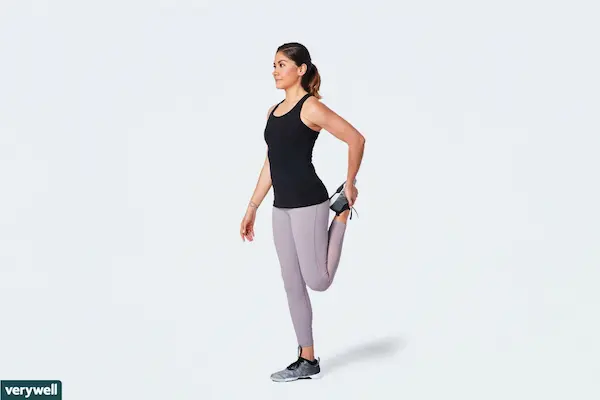
Bend the front knee slightly while keeping the back leg extended and your torso upright, feeling a stretch in the front of your right hip and thigh.
Stay in this position for around twenty to thirty seconds as you breathe steadily, then switch sides by stepping the opposite leg back.
Modification and safety notes for stretch five
- If balance feels shaky, place your free hand on the desk or wall for extra stability.
- People with knee sensitivity may keep the back leg slightly bent and reduce the distance between the feet.
- Desk workers wearing heels should either remove them or keep the stretch very small to protect the ankles.
Stretch six, hamstring and calf stretch from the chair
Sit back down and slide toward the front edge of the chair, then extend your right leg forward with the heel on the floor and toes pointing upward.
Keep your left foot flat on the ground and place both hands on the left thigh for support.
With a long spine, hinge gently from your hips toward the extended leg until you feel a comfortable stretch along the back of the thigh and possibly down to the calf.
Hold this position for twenty to thirty seconds, breathing calmly and avoiding rounding your back.
Return upright with control, then switch legs and repeat the same process on the other side.
Modification and safety notes for stretch six
- People with low back issues should keep the torso more upright and focus on lightly activating the abdominal muscles.
- If the stretch feels too intense, bend the extended knee slightly to reduce tension.
- Anyone with nerve related symptoms, such as strong tingling or shooting pain, should reduce the range and consult a professional.
Stretch seven, gentle standing full body reach
Stand with your feet about hip width apart and distribute your weight evenly between both legs.
Let your arms relax by your sides, then slowly raise them outward and upward until your hands reach overhead or as high as is comfortable.
Imagine creating space between each rib as you lengthen through the sides of your body.
Hold the reach for fifteen to twenty seconds while breathing deeply, feeling your entire front body open and your spine extend.
Lower your arms with control and repeat once or twice if that feels pleasant.
Modification and safety notes for stretch seven
- If raising both arms triggers shoulder discomfort, try lifting one arm at a time and alternate sides.
- Desk workers who feel lightheaded when lifting the arms overhead should move more slowly and keep the gaze straight ahead.
- Anyone with balance concerns can stand close to a wall or keep one hand on the desk.
Stretch eight, calming forward fold variation to finish
To close the sequence, stand behind your chair and hold the backrest with both hands, arms extended but not locked.
Walk your feet backward while hinging at the hips until your torso is roughly parallel to the floor and your arms form a long line from the shoulders.
Let your head line up with your upper arms and soften your knees slightly to avoid strain.
Feel a gentle stretch along your back, shoulders, and possibly the backs of your legs while you breathe slowly.
Stay for twenty to thirty seconds, then walk your feet back toward the chair and rest in a comfortable standing posture.
Modification and safety notes for stretch eight
- If dizziness appears when lowering the head, keep the torso higher and the head more aligned with the chest.
- People with high blood pressure or specific medical advice about head below heart positions should follow their professional guidance first.
- Desk workers who experience discomfort in the shoulders can bend the elbows slightly and bring the hands a bit closer to the body.
Timing, frequency, and progression for your light stretching routine
Knowing how long to hold each stretch, how often to repeat the sequence, and how to progress safely over time makes your practice more intentional and effective.
Morning sessions can act as a gentle warm up for the day, while midday or late afternoon sessions help reset posture and relieve accumulation of tension.
Suggested timing structure for beginners
- Hold each individual stretch for roughly twenty to thirty seconds.
- Move through the full sequence once for a short ten minute routine.
- Repeat the entire flow a second time when you feel ready for slightly more intensity.
- Include at least one short warm up step before the deepest stretches.
- Finish every session with a calming position and a few slow breaths.
Consistency over weeks is more important than perfect adherence to exact seconds, so treat these numbers as gentle guides rather than strict rules.
Recommended weekly frequency for desk workers
- Start with two or three sessions per week if your body is very stiff or you are completely new to stretching.
- Build gradually toward four or five shorter sessions spread across the week once your routine feels familiar.
- Use micro breaks of one or two stretches during long workdays, even when you cannot perform the full sequence.
- Monitor how your body feels on days after stretching, aiming for pleasant looseness rather than strong soreness.
- Scale back temporarily if any repeated movement seems to aggravate discomfort instead of easing it.
How to adapt the routine to different bodies, desks, and work setups
Not every workspace looks the same and not every body responds identically to a given movement, so adapting the flow makes it more inclusive and realistic.
Small adjustments can turn a general sequence into your own personal routine that honors limitations, sensitivities, and preferences.
Adaptations when your chair has wheels or no armrests
- Place the chair against a wall before starting to prevent it from rolling away during certain stretches.
- Hold the desk instead of the chair back when you need extra stability for balance related movements.
- Shorten the range of motion in any direction where the chair movement makes you feel uncertain or wobbly.
Adaptations for very tight muscles or reduced mobility
- Stay closer to your starting position and focus more on breathing and awareness than on reaching far.
- Use cushions, folded towels, or even your jacket to support areas that feel strained by direct contact with the chair.
- Rest for a few seconds between stretches if you notice fatigue building up, especially when standing.
Adaptations for open plan offices or shared workspaces
- Select seated stretches when you prefer to remain more discreet in front of colleagues.
- Use a quiet meeting room or a corridor for the standing portions of the sequence if that feels more comfortable.
- Shorten the routine to three or four key stretches when time and privacy are limited, and complete the full flow at home.
Using photos or illustrations to support your practice
Although the written instructions already guide you through each movement, many people find it easier to follow a routine when they can see images that demonstrate alignment and posture.
Photographed demos can clarify where the head, shoulders, hips, knees, and feet should be in relation to each other, which increases safety and confidence.
Adding simple arrows or short captions near each image helps highlight the direction of movement, the parts of the body being targeted, and any common mistakes to avoid.
Ideas for simple illustrated cues for each stretch
- Neck and shoulder release, a picture from the side showing the ear gently dropping toward the shoulder without collapsing posture.
- Chest opening, a front view where the collarbones look wide and the shoulders sit low, not scrunched near the ears.
- Side stretch, a diagonal shot that makes it easy to see the long curve from hip to fingertips without leaning too far.
- Seated twist, a photo emphasizing the tall spine before rotation so the twist does not become a slouch.
- Hamstring stretch, an image capturing the straight extended leg and neutral back posture when hinging from the hips.
Using photos you take yourself, with comfortable clothing and natural lighting, can bring authenticity and relatability to your stretching guide or personal reference materials.
Mindset tips to stay consistent with your light stretching habit
Building a new routine is not only a physical task but also a mental one, particularly when your days already feel full and your energy is precious.
A few mindset shifts can make the practice of gentle stretches feel less like another obligation and more like a small daily gift to yourself.
Practical strategies to keep your mobility routine alive
- Attach the routine to an existing habit, such as after your first coffee, after lunch, or after closing your laptop.
- Set a recurring reminder on your phone or calendar with kind wording rather than strict commands.
- Celebrate completion of even a shortened routine, recognizing that something is always better than nothing.
- Track your sessions lightly on a notebook or app, focusing on trends over weeks instead of perfect streaks.
- Invite a coworker or friend to join for a short stretch break, adding accountability and a bit of fun.
Approaching the habit with curiosity and self compassion usually leads to better long term results than relying on pressure and criticism.